Friday, April 30, 2010

The Human Yes


Do you remember him? Or her? That one single teacher who in one brief moment looked you straight in the heart and recognized the center of your being?

Kaylin Haught in “God Says Yes to Me” writes about the Royal YES. Yet there is something about the human yes that is so solid, so physical, so real it almost feels as one of those seeds you buy in small, paper packets.

The resulting flowers have names like Confidence, Courage, Determination.

One of those seeds was planted in me the first year of university. I was young and had yet to understand the concept of education. Learning, I thought, was all about remembering and repeating the words of others. I had no idea discovering your own was its main concern.

My philosophy tutor was a dark, handsome American who insisted on calling me Crete. My name has little to do with the Greek Island, but I was too shy to object. Also I was too shy to believe I had a voice that mattered.

Week after week the American would look at me with sad, brown eyes, and plead, “But what do YOU think, Crete, what is YOUR opinion?” I was unsure as to what he meant, uncertain what he wanted. For what had MY opinion to do with it? Was I not here to learn my Plato and Socrates?

Then came the last day of term. My paper was all about art. About the necessity of art. About how we create, and how our creation in turn creates us. About how the two mirror each other.

We were five students in our tutorial, all crammed into the professor’s small office. Having slumped down on our chairs, we were quiet, waiting for the verdict. One by one the papers were handed out by the American, accompanied with a small remark. When he turned to me, there was a smile in his eyes. Yes, he exclaimed, Yes, Yes, YESSS!

Wednesday, April 28, 2010

Yes Again


I’m walking Kaylin Haught’s poem God Says Yes to Me this week.

The title says it all.

Monday, April 26, 2010

Yes, Yes, Yes.


When I walked through the park this morning, I asked God, if it was okay I treat the giant subject of YES and NO. She answered me as she did Kaylin Haught in her poem God Says Yes to Me (see below).

I continued. Is it okay I admit to my mind being a battleground sometimes, the YESs and the NOs lined up on each side of the combat zone, ready for action? She answered me, honey (she calls me that sometimes), you can do exactly what you want to.

Thanks God, I said. Though I wasn’t sure she would be pleased with what I had to say.

For here’s the thing, I am a warmonger. Or rather, I am a field of conflict. I line my YESs and NOs on each side, and wait. At times the soldiers look like tiny, tin figures, clothed in historic uniforms with bright red jackets and tall, silly hats. That’s when I stand by the sidelines and giggle.

But there are times when the YESs and the NOs are dressed up for modern warfare. They resemble something from outer space, their bulky, camouflaged uniforms bejeweled by automatic weapons and bulletproof vests. These soldiers mean business.

When I see them, I duck for cover. Till I slowly raise one arm, V my two fingers and plead with a small, meek voice: Peace! Please!

I asked God, if it was time to be the diplomat and listen to what both parties had to say. She nodded.

So I called for the NO team to step forward.

A tall man with a sleek suit and shiny black shoes appeared. He said - I’m here to protect you. I am your body guard and your border patrol. Remember the time you didn’t want to attend that meeting? Do you recall when you didn’t want to do that job? Do you recognize all those times I have stopped incoming thoughts of fear and suspicion? Have you noticed how I intervene when you think you have to, but you don’t want to?

I bowed my head and said Thank You!

The YES team had equally good arguments.

I am your sun (no less!), she said, a woman dressed in a silky red shirt and skirt and shoes with small, sparkly diamonds. I am the one who bought your tickets to England first time you went, I am the one who opened your arms and your womb (she’s not shy, this girl!), I let you stay at home when the boys were small, I urged you to travel to France last month, I gave you permission to blog.

I said, I’m sorry YES, I had no idea.

For actually, I had confused the YES with the NO!

I had thought it was “YES, you are a lazy bastard” that had prevented me from doing that job. I had imagined it was “NO, you are certainly no superwoman” that had made me stay at home with the boys.

I asked God if she thinks I am a bit confused at times. She said yes. I said, do you think I possibly might get it right? Sweetcakes, she said, who knows where she picked that up, what I’m telling you is yes, yes, yes.


***

God Says Yes to Me - Kaylin Haught

I asked God if it was okay to be melodramatic
and she said yes
I asked her if it was okay to be short
and she said it sure is
I asked her if I could wear nail polish
or not wear nail polish
and she said honey
she calls me that sometimes
she said you can do just exactly
what you want to
Thanks God I said
And is it even okay if I don't paragraph
my letters
Sweetcakes God said
who knows where she picked that up
what I'm telling you is
Yes Yes Yes

Friday, April 23, 2010

Chains.


Today was the day I stopped writing in the middle of a sentence to ask myself - whatever am I doing? Trying to write about poems is like being the mouse next to the elephant - my writing hand is so very, very small, my legs so incredibly short.

Yet I remind myself that this is not so much about the poem itself, which has its own giant feet to stand on. This is more about the experience of eating it, word by word, sentence by sentence. This is about chewing it, tasting it, sensing it slide down my throat. This is about letting the poem enter my bloodstream, feel how pumps round and round, nourishing my cells.

And when Sharon Olds’ My Son the Man enters my world this is what happens. I laugh. I cry. I am reminded of a cuddly little bundle of soft flesh tossed up in the air, and then caught again. I remember the boy who followed me wherever I went, even into the loo.

Then he grew taller, more bony. Until one day he walks next to me in the park, thin, but with broad shoulders and inquisitive eyes. It is the era of nine-eleven, of a proclaimed good world and a bad world, of axis of evil. People are distressed, depressed, the papers are full of it, they never give us a moment to rest.

“I’m off to Damascus”, he says.

I stop.
I stare.
“What?”

Then there is no more talk of it. For one week. Three. I hope the idea will float away, like a cloud in the sky.

“....This was not what I had in mind when he pressed up through me like a
sealed trunk through the ice of the Hudson,
snapped the padlock, unsnaked the chains,
and appeared in my arms.....”

Did I ever imagine he would counter my wishes? (Hah!)
Did I ever realize he would open the door, to shut it firmly behind him? (Hah!)
Did I ever think there was a world out there, that I would never be part of? (Hah! Hah!)

“........Now he looks at me
the way Houdini studied a box
to learn the way out, then smiled and let himself be manacled.”

When the tickets are bought, he looks at me. And smiles.

Wednesday, April 21, 2010

A License to Let Go.


I am reading Sharon Olds’ My Son the Man while walking the paths of the morning.

Sweet motherhood. I could write about it for weeks. For months. Years. It could, in fact, be the script of my life.

Yet I would miss the heart of the matter did I not realize the subtle twists of mothering. To mother my child also implies the child be me.

It seems no time since I helped Alex into his play suit, placed him in the pram, and walked towards “Mathilde”, the huge, toy adventure ship in the far corner of the park. On our way we would pass the statues: men and women and children with skin of granite and bronze, expressing inner worlds in outer bodies; Eros, The Monolith, The Wheel of life. Clustered in groups or bordering the bridge were the old and the young, engaged in love and lust, calm and conflict, wrestling themselves and others, turning, twisting, toiling.

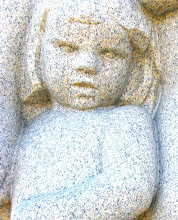
In the middle of the bridge is the Boy, the famous little Angry Boy, frozen in an eternal cry, hands clenched, feet stamping.

Alex was familiar with the Boy. We would stop sometimes, pat his bronze fists, or stroke his cold, metal toes. We would talk to him, ask what was the matter. And when at home, the Boy was there to greet us from a poster on Alex’ bedroom wall.

Why had I brought the statue home? Was it to teach Alex something further about the art and esthetics of the park? Was it for the recognition, as in “Look, Alex, the Boy on the bridge!”?

Or was it to give him that permission to protest, to stamp his feet, to insist, persist, not to give in, give up, to express rather than keep inside all that wild and eager energy?

Or was it my own permission I was seeking, my own longing for a license to let go?

Monday, April 19, 2010

Growth.


Sharon Olds in her poem My Son the Man is facing the inevitable. Being a mother is not just seeing a son grow up. It is also to accept his growth sideways, his breaking free from she who gave life.

“.......It seems
no time since I would help him put on his sleeper,
guide his calves into the gold interior,
zip him up and toss him up and
catch his weight.......”

As mothers we give birth. We nurse. With our bodies, hearts and minds we delve into the pool of parenthood. We stay by that water, faithfully, drinking it, swimming it, or merely touching it with our hands. Sometimes when drinking, we choke. Sometimes when swimming, the easy and elegant breast stroke is no more than the survivor’s splashing of arms and legs.

Then one day the very center of this activity is gone. What was once the soft, the fleshy, the cuddly small body, is now the tall, the wide, the bony. The boy has become The man.

I can see him, how has grown. Evolved. Where I once had to bend down and kiss the top of his scalp, I now have to tip toe to reach his cheek.

Then I look into that mirror. The girl - have I noticed how she has grown?

Friday, April 16, 2010

Wasted?


What is to waste a life?

James Wright has a suggestion:


Lying in a Hammock at William Duffy's Farm in Pine Island, Minnesota

Over my head, I see the bronze butterfly, 

Asleep on the black trunk, 

Blowing like a leaf in green shadow. 

Down the ravine behind the empty house, 

The cowbells follow one another 

Into the distances of the afternoon. 

To my right, 

In a field of sunlight between two pines, 

The droppings of last year's horses 

Blaze up into golden stones. 

I lean back, as the evening darkens and comes on. 

A chicken hawk floats over, looking for home.

I have wasted my life.


That last line. It hurts.